 Work Time
The first and most consequential decision you will make is whether you want a cooling-only ductless mini-split or a ductless heat pump model that both cools in summer and heats in the shoulder seasons.
Cooling-Only Ductless Systems
A cooling-only ductless system does exactly what the name suggests — it removes heat from your home in summer and delivers conditioned, cool air into each zone. These systems are typically less expensive upfront and make sense for homeowners who already have a reliable heating system in place and simply need supplemental or whole-home cooling.
Ductless Heat Pumps
A ductless heat pump runs the refrigerant cycle in reverse during cooler months, extracting heat from the outside air and transferring it indoors. Modern cold-climate heat pumps from brands like GREE and Daikin maintain effective heating output even when outdoor temperatures drop to -25°C or -30°C — well within the range of Ontario winters.
For homeowners in Toronto and the GTA, a heat pump model provides year-round value: efficient cooling in summer and supplemental or primary heating from fall through spring. Heat pump models also typically qualify for a broader range of government rebates in Ontario, which can significantly reduce the net purchase price.
Our recommendation for most Ontario homeowners: unless budget is the primary constraint, a heat pump model offers far better long-term value than a cooling-only unit.
A zone is any area served by a single indoor air handler unit. Each indoor unit can be set to a different temperature independently, giving occupants control over their individual spaces. Getting the zone count right from the start saves you money and avoids costly add-ons later.
When a Single-Zone System Makes Sense
A single-zone system — one outdoor unit connected to one indoor unit — is the right choice when you have a specific, defined area that needs cooling and your existing HVAC system handles the rest of your home adequately. Common single-zone applications in Ontario include:
- A home addition or sunroom that sits outside the reach of your central ducted system.
- A finished basement that runs warm in summer.
- A detached garage or workshop used as a home office or gym.
- A master bedroom or specific room where occupants want independent temperature control.
When a Multi-Zone System Makes Sense
A multi-zone system connects one outdoor condenser to two, three, four, or five indoor units. Each unit operates independently, so different zones can be set to different temperatures simultaneously. A multi-zone system makes sense when:
- You want to cool multiple rooms or floors without installing ductwork.
- Your home has no existing central AC and you want a complete cooling solution.
- You are in an older home, heritage property, or high-rise condo where ductwork installation is not practical.
- You want to eliminate hot and cold spots caused by an uneven central ducted system.
- You want the energy efficiency of cooling only occupied zones rather than the whole house.
A good rule of thumb: if you need cooling in more than two separate areas of your home, a multi-zone system will almost always be more cost-effective than multiple single-zone units — because you share one outdoor condenser unit across all indoor handlers.
Correct sizing is critical. An undersized system will run continuously and still fail to cool the space adequately. An oversized system will short-cycle — switching on and off too frequently — which prevents proper dehumidification, wastes energy, and accelerates component wear.
The unit of cooling capacity is BTU (British Thermal Units) per hour. As a general guide for Ontario homes with average insulation and ceiling heights of 8 to 9 feet:
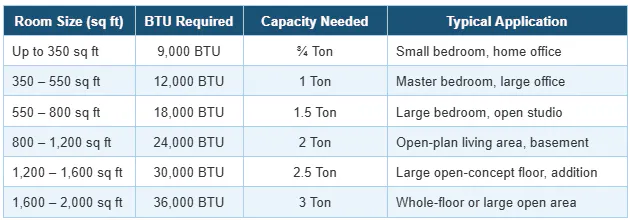
Important: These are general guidelines. Factors including ceiling height, window area, sun exposure, insulation quality, and the number of occupants all affect the actual capacity needed. A proper Manual J load calculation performed by a certified technician is the only reliable way to confirm the right sizing for each zone.
SEER — Seasonal Energy Efficiency Ratio — measures how efficiently an air conditioner uses electricity to deliver cooling over the course of a season. The higher the SEER rating, the less electricity the unit consumes to produce the same cooling output, which translates directly into lower hydro bills.
In Ontario, the minimum SEER rating for new ductless systems is 14. However, most systems sold today significantly exceed this minimum — and for good reason. Here is how SEER ratings break down and what they mean for your decision:
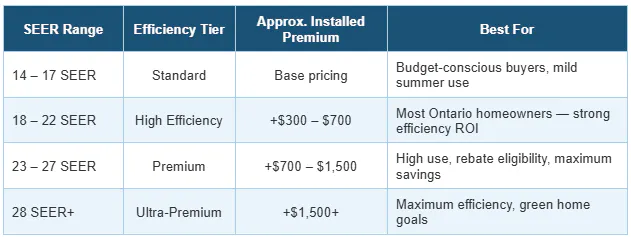
For most Ontario homeowners, a system in the 18 to 22 SEER range hits the sweet spot between upfront cost and long-term energy savings. Premium SEER ratings above 23 make the strongest financial sense for homeowners who run their system heavily through the summer or who want to maximize rebate eligibility.
Not all ductless systems are created equal. Brand matters significantly when it comes to long-term reliability, warranty support, cold-climate performance, and the availability of local certified technicians who know the equipment. Here is a practical summary of the brands Constant Home Comfort carries and recommends for Ontario homeowners:
Daikin — Best for Long-Term Reliability and Premium Engineering
Daikin is the global pioneer of split-system technology and remains the world's largest HVAC manufacturer. Their ductless systems are consistently ranked among the quietest, most efficient, and most reliable on the market. Daikin's Aurora series is specifically engineered for cold climates, maintaining effective heating output down to -25°C. Ideal for homeowners who want the best and are willing to invest accordingly.
GREE — Best Value with Exceptional Cold-Climate Performance
GREE manufactures more air conditioners annually than any other company on earth, and their technology has matured into a genuinely premium product at an accessible price. Their Sapphire and Flexx series achieve SEER ratings exceeding 30 — the highest in the industry — and their cold-climate heat pump models operate effectively down to -30°C. GREE is the top recommendation for Ontario homeowners who want maximum efficiency and cold-climate capability without the premium brand price tag.
Lennox — Best for Quiet Operation and Smart Home Integration
Lennox ductless systems are engineered to exceptional noise standards, with select indoor units operating as quietly as 19 decibels. Their systems integrate seamlessly with Lennox's iComfort smart thermostat ecosystem and major smart home platforms. The right choice for homeowners who prioritize near-silent operation in bedrooms and living areas, or who want full smart-home connectivity.
Bosch — Best for Build Quality and Durability
Bosch HVAC brings German engineering precision to the ductless category. Their systems are built to tight quality tolerances and are designed to perform reliably across Ontario's wide seasonal temperature range. Bosch is a strong choice for homeowners who value durability and who trust the brand from experience with other Bosch home products.
Where your units are installed affects both the performance of your system and the aesthetics of your home. Here are the key placement principles your installer should follow:
Indoor Unit Placement
- Mount the indoor unit high on an interior wall — heat rises, so positioning the unit near the ceiling allows cool air to be distributed evenly downward through the room.
- Avoid placing units directly above beds, sofas, or workstations where air flow will blow directly on occupants at close range.
- Position units so the airflow path covers the entire room, not just one corner or wall.
- Ensure there is adequate clearance above and to the sides of the unit for unrestricted airflow — most manufacturers specify a minimum of 6 to 12 inches of clearance.
- Choose a wall that allows a relatively short, direct route to the exterior for the refrigerant line set.
Outdoor Unit Placement
- Install the outdoor condenser in a location with unrestricted airflow — avoid enclosing it in tight spaces, fencing, or dense shrubbery.
- Keep the unit accessible for annual maintenance servicing.
- In Ontario, mount outdoor units on wall brackets or elevated platforms to keep them above the typical snow line — this is especially important for heat pump models that operate through winter.
- Minimize the distance between the outdoor unit and the indoor units where possible — longer refrigerant line runs add cost and can reduce efficiency.
- Avoid south-facing walls in full afternoon sun if possible — excessive heat on the condenser reduces efficiency during peak cooling demand.
Ontario homeowners purchasing qualifying ductless heat pump systems can access meaningful government rebates that reduce the net cost of their installation significantly. Key programs to be aware of include:
- Canada Greener Homes Grant — offers rebates of up to $5,000 for qualifying heat pump installations when combined with a pre- and post-installation home energy audit through Natural Resources Canada. This is one of the most substantial rebate opportunities available to Ontario homeowners.
- Enbridge Gas Home Efficiency Rebate Plus — provides rebates for homeowners who install qualifying heat pump systems that reduce natural gas heating consumption.
- Hydro One and municipal utility rebates — availability and value vary by utility and region across Ontario.
- Manufacturer promotional rebates — brands including Daikin and GREE periodically offer instant rebates on select models, which Constant Home Comfort applies at the time of purchase.
Rebate programs have eligibility requirements, application windows, and audit processes that must be followed correctly to receive the full benefit. Our team will walk you through every program you qualify for, handle the paperwork where possible, and make sure no rebate dollar is left on the table.
Not every HVAC contractor provides the same quality of installation, equipment, or after-sale support. Before signing any quote, make sure you get clear answers to these questions:
- Is your company licensed and insured in Ontario for HVAC installation?
- Are your technicians certified to handle refrigerants under the Environmental Protection Act?
- Does your quote include all labour, line sets, conduit, permits, and commissioning — or are there items billed separately?
- What brand and model are you quoting, and what is the SEER rating?
- What warranty does the manufacturer provide on parts and compressor?
- Do you offer a labour warranty on the installation itself?
- Will you help me apply for available rebates?
- Do you offer financing?
- Who do I call if the system needs service or repairs after installation?
At Constant Home Comfort, every one of these questions has a clear, straightforward answer before you commit to anything.
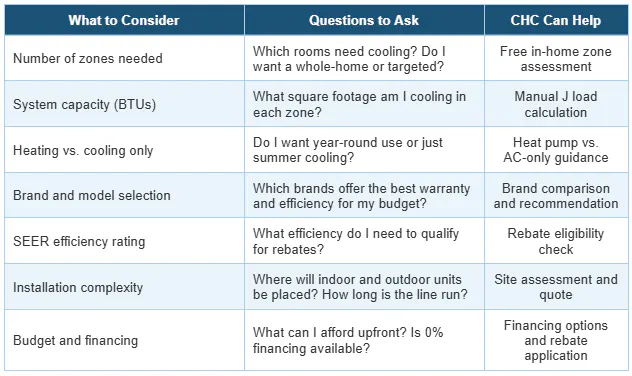
Use this quick-reference checklist to make sure you have covered every consideration before making your purchase decision:
Buying Oversized Equipment
Bigger is not better with HVAC equipment. An oversized unit short-cycles — turning on and off rapidly rather than running through full cooling cycles. This prevents proper dehumidification, creates uneven temperatures, and wears out components faster. Always size based on a proper load calculation, not a rough guess.
Choosing the Lowest Quote Without Reading What Is Included
A quote that looks significantly cheaper than the competition often excludes key components — line set conduit, permits, commissioning, or a labour warranty. Always ask for a written, itemized quote and compare line by line before making a decision on price alone.
Ignoring Cold-Climate Performance Ratings
In Ontario, if you plan to use your ductless system for heating through spring and fall — or even into winter — the system's rated minimum operating temperature matters enormously. A standard heat pump that cuts out at 5°C is effectively useless for shoulder-season heating in Ontario. Make sure your system is rated for cold-climate operation down to at least -15°C, and ideally -25°C or lower.
Skipping Annual Maintenance
A ductless system that is not serviced annually will lose efficiency, have a shorter lifespan, and is more likely to fail at the worst possible time. Annual maintenance — including coil cleaning, refrigerant checks, and electrical inspections — is as important for a ductless system as it is for a central AC unit.
Not Asking About Rebate Eligibility Before Buying
Rebate programs in Ontario have specific eligibility requirements — including minimum SEER ratings — that must be met by the equipment you purchase. If you choose a system that falls below the rebate threshold, you cannot claim the rebate retroactively. Always confirm eligibility before finalizing your equipment selection.
Choosing the right ductless system is only half of the equation. Choosing the right company to supply and install it is equally important. Here is why thousands of Ontario homeowners trust Constant Home Comfort for their ductless AC needs:
- Carrier of the industry's top ductless brands: Daikin, GREE, Lennox, and Bosch — all in one place.
- Certified, experienced installation teams who have completed hundreds of ductless installations across Ontario.
- Free, no-obligation in-home assessments with proper zone and load analysis — not guesswork.
- Transparent, all-in quotes with no hidden costs added at installation.
- 0% financing for 12 months on qualifying purchases, with extended terms available.
- Rebate navigation — we identify every program you qualify for and help you access the full benefit.
- 24/7 post-installation support and emergency service for systems we install.
- Service across Toronto, GTA, Hamilton, Ottawa, Barrie, Burlington, Waterloo, London, and all of Ontario.
What size ductless AC do I need for a 1,000 sq ft space in Ontario?
A 1,000 square foot open space with standard ceilings and average insulation typically requires approximately 24,000 BTU (2-ton) of cooling capacity. However, ceiling height, window area, sun exposure, and insulation quality all affect the final sizing recommendation. A proper load calculation is always advisable before purchasing.
Should I buy a heat pump model or a cooling-only ductless system?
For most Ontario homeowners, a heat pump model provides significantly better long-term value. The ability to heat through shoulder seasons, combined with stronger rebate eligibility and only a modest price premium over cooling-only units, makes the heat pump the smarter investment for the majority of buyers.
How long does ductless AC installation take?
A single-zone installation is typically completed in half a day. A two- or three-zone system takes a full day. Larger multi-zone installations with complex line routing may require two days. Your Constant Home Comfort technician will give you a specific time estimate at the time of the site assessment.
Can I install a ductless AC myself to save money?
Ductless system installation involves handling refrigerants, which requires certification under Canada's Environmental Protection Act. It also involves electrical work that must meet Ontario Electrical Safety Authority requirements. DIY installation is not legal, voids the manufacturer warranty, and carries real safety risks. Professional installation by a certified technician is required.
What maintenance does a ductless system require?
The key maintenance tasks are: cleaning the indoor unit's air filters every 4 to 6 weeks during active use (a simple task homeowners can do themselves), and scheduling a professional annual tune-up that includes coil cleaning, refrigerant level checks, electrical inspection, and a full system test. Constant Home Comfort offers AC maintenance plans that make annual servicing simple and affordable.
How do I know if I qualify for Ontario ductless AC rebates?
The primary eligibility factors are the system's efficiency rating (SEER) and whether it is a heat pump model. Most major rebate programs require a minimum SEER of 18 to 20 and a heat pump configuration. Constant Home Comfort will confirm your rebate eligibility during your free consultation and recommend models that maximize your rebate entitlement.
The best ductless system is the one that is correctly sized, properly installed, and matched to your home's specific layout and cooling needs. The only way to get that right is to have a professional assess your space — and that assessment is completely free when you book with Constant Home Comfort.
Our HVAC advisors will evaluate your home, recommend the right system configuration and brand, confirm every rebate you qualify for, and give you a clear all-in quote with financing options included. No pressure, no obligation — just the information you need to make a confident decision.
Call us today at 1 (888) 675-5907 or request your free assessment online. We serve homeowners across Toronto, the GTA, Hamilton, Ottawa, Barrie, Burlington, Waterloo, London, and all of Ontario.