 Work Time
The best air cleaner for your home depends entirely on what you're trying to solve. Before looking at products, get clear on the specific problem you're dealing with:
Allergens and dust:
If you or a family member suffers from seasonal allergies, asthma, or dust sensitivity, you need a system with a high-efficiency particulate filter — true HEPA or a MERV 13+ media filter — that captures fine particles like pollen, dust mites, and pet dander.
Bacteria, viruses, and mould:
For pathogen control — especially relevant during cold and flu season in Ontario's long winters — look for systems that include UV-C germicidal technology or photocatalytic oxidation (PCO) as a filtration layer.
Odours, smoke, and VOCs:
Cooking odours, pet smells, cigarette smoke, wildfire smoke infiltration, and off-gassing from new furniture or flooring require activated carbon filtration. Particulate filters alone will not eliminate gases and odours.
General air quality improvement:
If your goal is overall indoor air quality with no single dominant concern, a multi-stage whole-home system covering particles, pathogens, and gases is the most comprehensive solution.
MERV Rating (Minimum Efficiency Reporting Value)
MERV is the industry-standard rating for how effectively a filter captures particles. The scale runs from 1 to 20 — the higher the number, the finer the particles it traps.
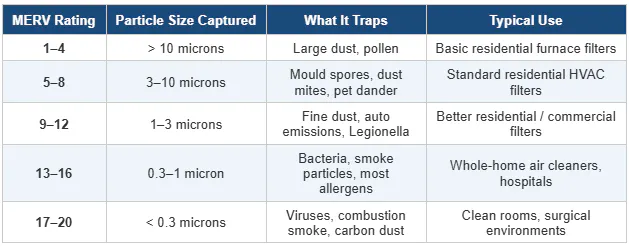
For residential whole-home use, MERV 11–13 is the sweet spot — high enough to capture most allergens and fine particles, without restricting airflow through your furnace. Going too high (MERV 16+) without the right HVAC setup can strain your system and reduce efficiency.
CADR Score (Clean Air Delivery Rate)
CADR is used primarily for portable air purifiers and measures how quickly a unit cleans a specific volume of air of a specific pollutant (dust, smoke, pollen). It's expressed in cubic feet per minute (CFM).
A general rule of thumb: your CADR score should be at least two-thirds of your room's square footage. So for a 300 sq ft room, look for a CADR of at least 200.
Note: CADR is not used to rate whole-home systems, which are evaluated based on airflow capacity and MERV rating instead.
True HEPA vs. HEPA-Type
True HEPA filters are independently certified to capture 99.97% of particles at 0.3 microns. HEPA-type or HEPA-like filters are marketing terms with no standardized certification — they may perform significantly worse. When buying a portable unit, always confirm it carries a true HEPA designation.
Whole-home air cleaners from reputable HVAC brands are rated by MERV rather than HEPA certification, which is a more appropriate standard for ducted systems.
ACH — Air Changes per Hour
ACH measures how many times per hour a system completely filters the air in a given space. For allergy and asthma sufferers, look for a minimum of 4–5 ACH in the rooms where you spend the most time. A qualified HVAC technician can calculate this for a whole-home system based on your home's cubic footage and your HVAC system's airflow.
This is the most important decision in your buying process. Here's how to think about it:
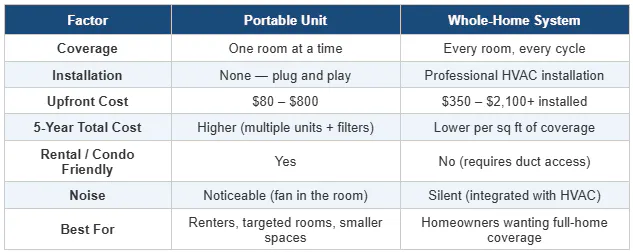
Once you've decided between portable and whole-home, the next step is choosing the right filtration technology for your needs.
HEPA / Media Filtration — Best for Allergens and General Particulates
Ideal for households where dust, pollen, pet dander, and mould spores are the primary concern. A whole-home media filter at MERV 11–13 is the most cost-effective entry point for full-home allergen control. Filters need replacement every 6–12 months.
Electronic / Electrostatic — Best for Long-Term Value
Uses electrical charge to capture particles on washable plates. No replacement filter costs make this the better long-term value for many households, especially those who want to minimize ongoing maintenance. Lennox PureAir and similar integrated systems use this technology.
UV-C Germicidal — Best for Pathogen Control
Adds a layer of virus, bacteria, and mould neutralization to any filtration system. Highly recommended for households with young children, elderly members, anyone immunocompromised, or anyone who experienced recurring illness during winter months. UV bulbs require annual replacement.
Activated Carbon — Best for Odours and VOCs
Essential if your household deals with persistent odours, has recently undergone renovation, or is located in an area with outdoor air quality concerns (traffic, industrial, wildfire smoke). Carbon layers are commonly included as a secondary stage in multi-stage systems.
Multi-Stage / Combination Systems — Best for Complete Protection
For households where multiple concerns overlap — allergens, pathogens, and odours — a multi-stage system combining HEPA or electronic filtration with UV-C and activated carbon is the most comprehensive solution. Premium brands like Lennox offer fully integrated systems designed to work as part of your complete HVAC setup.
An undersized air cleaner is one of the most common buying mistakes. If the system can't handle your home's airflow volume, it won't deliver the advertised performance — regardless of how good the technology is.
For portable units:
- Check the manufacturer's square footage coverage rating
- Choose a unit rated for at least 20–30% more space than the room you're treating
For whole-home systems:
- Sizing is based on your furnace or air handler's CFM (cubic feet per minute) airflow rating
- The filter must not restrict airflow beyond your HVAC system's tolerance — this is why professional sizing matters
- A technician will measure your duct dimensions, assess your existing equipment, and recommend the right model and filter grade
Ontario's climate and geography create a specific set of indoor air quality challenges that should inform your buying decision:
Long Heating Season = More Recirculated Indoor Air
From roughly October through April, Ontario homes run with windows sealed and heating systems cycling continuously. Every airborne contaminant in your home — dust, pet dander, mould spores, VOCs — recirculates repeatedly. A whole-home air cleaner running in sync with your furnace is the only way to consistently address this.
Spring and Fall Pollen
The GTA and surrounding regions see significant tree pollen in April–May and ragweed pollen in August–September. If anyone in your household has seasonal allergies, MERV 11+ filtration running during these windows dramatically reduces indoor allergen levels.
Wildfire Smoke
Smoke infiltration from wildfires has become an increasingly frequent summer concern in Ontario. Wildfire smoke particles are extremely fine (PM2.5 range) and require MERV 13+ or true HEPA filtration to capture effectively. An activated carbon layer also helps with the associated odour.
Older Homes and Renovation Off-Gassing
Many Toronto and GTA homes are older builds with higher dust accumulation in ductwork, older insulation, and renovation activity that releases particulates and VOCs. A multi-stage system with carbon filtration is particularly valuable in these homes.
Before finalizing any air cleaner purchase — especially a whole-home system — ask these questions:
- What MERV rating or filtration standard does this system meet?
- Is it properly sized for my home's square footage and HVAC airflow capacity?
- What are the annual maintenance costs — filters, bulbs, or servicing?
- Does this system require any duct modifications, and if so, what is the cost?
- What warranty does the unit carry, and is labour covered?
- Will this system work with my existing furnace and thermostat?
- Is there a service plan available to keep the system performing at its best?
We carry and install systems from industry-leading brands that integrate seamlessly with your existing HVAC equipment. When evaluating brands, look for:
- Proven MERV or performance certification, not just marketing claims
- Replacement parts that are widely available in Canada
- Compatibility with major furnace and air handler brands
- Strong warranty terms — minimum 5 years on the unit
Lennox, one of the premium brands we carry, offers whole-home air quality systems that combine electronic filtration, UV-C, and carbon filtration in a single integrated unit. Their systems are engineered to work directly with Lennox furnaces and air handlers, with smart controls accessible through the iComfort thermostat platform.
Our team will always recommend the system that best fits your specific home, budget, and air quality concerns — not simply the most expensive option.
No air cleaner delivers its rated performance if it isn't maintained. Here's a simple maintenance schedule to follow:
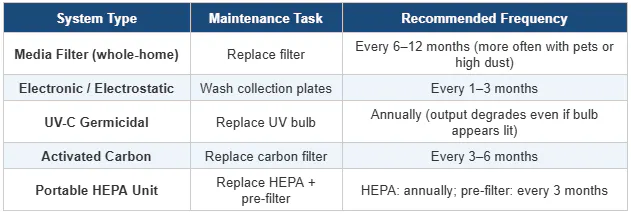
Constant Home Comfort offers annual maintenance plans that cover your air cleaner as part of your complete HVAC system service — so you never have to remember when your filter is due.
What is the best air cleaner for allergies in Ontario?
For allergen control, look for a whole-home system with a MERV 13 or higher media filter, or an electronic air cleaner that captures particles down to 0.1 microns. Running in sync with your furnace during Ontario's spring pollen season and fall ragweed season will meaningfully reduce indoor allergen levels. A UV-C add-on provides extra protection against mould spores.
Do I need a whole-home air cleaner if I already have a good furnace filter?
A standard 1-inch furnace filter (typically MERV 4–8) is designed to protect your HVAC equipment — not to improve your air quality. A whole-home air cleaner at MERV 11–13 or higher actively filters the air your family breathes. They serve very different purposes.
Can an air cleaner help with wildfire smoke?
Yes, but you need the right technology. Wildfire smoke contains extremely fine particles (PM2.5) that require MERV 13+ or true HEPA filtration to capture. An activated carbon layer is also important for odour control. If wildfire smoke is a recurring concern for your area, discuss a multi-stage system with our team.
How long does a whole-home air cleaner last?
A quality whole-home air cleaner, properly maintained, typically lasts 10–15 years. Electronic systems with washable plates tend to have longer lifespans with minimal part replacement. Media filter housings are essentially permanent — you only replace the filter media itself.
Will an air cleaner make my home smell different?
A well-functioning air cleaner with an activated carbon layer will noticeably reduce household odours over time — pet smells, cooking, and mustiness. Some people notice the absence of odours rather than any new smell. Air cleaners that use ionization or ozone as a purification method can produce a faint ozone smell, which is why we recommend systems that use physical or UV filtration rather than ozone-generating technology.
Choosing the right air cleaner is easier with a professional assessment. Our licensed HVAC technicians will evaluate your home, review your existing system, and recommend the specific model that fits your family's needs and your budget — with full transparency on pricing and installation costs.
We serve Toronto, GTA, Hamilton, Ottawa, Barrie, London, Waterloo, Burlington, and communities across Ontario. Financing options available, including 0% interest plans.
Call us at 1 (888) 675-5907 or book your free in-home consultation online.
The right air cleaner for your home starts with the right advice.