 Work Time
Ontario's climate creates unique indoor air quality challenges. When outdoor temperatures fall below freezing, the cold air holds very little moisture. As that air enters your home and gets heated by your furnace, its relative humidity drops dramatically — often to levels well below what is considered healthy or comfortable.
Without a humidifier, indoor relative humidity during an Ontario winter can fall anywhere from 10% to 25%. At those levels, you will notice dry, itchy skin; cracked lips; irritated sinuses and throats; increased susceptibility to colds and flu; static electricity throughout the home; and damage to wood floors, furniture, cabinetry, and musical instruments. Paint can chip, drywall can crack, and window frames can shrink and warp.
A whole-home humidifier — installed directly on your furnace or air handler — automatically maintains your home's relative humidity within the ideal comfort range of 35% to 50%, all winter long, without any effort from you. Unlike portable room humidifiers, a whole-home system treats every room simultaneously and requires far less maintenance.
Before buying a humidifier, it helps to understand what relative humidity means and what levels you should be aiming for in your home. Relative humidity (RH) is the percentage of moisture in the air relative to how much moisture the air could hold at that temperature. Warm air holds more moisture than cold air, which is why heated indoor air becomes so dry in winter.
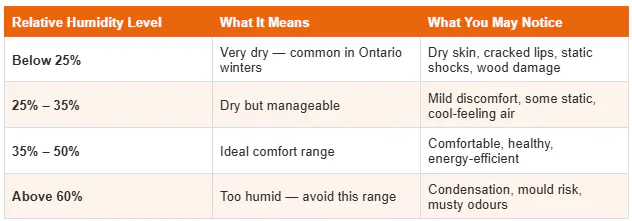
One important nuance for Ontario homeowners: the ideal indoor humidity level varies slightly with outdoor temperature. When it is extremely cold outside — say, minus 20°C or lower — you may need to reduce indoor humidity to around 30% to 35% to prevent condensation from forming on windows and exterior walls. A quality humidistat will help you monitor and adjust your settings automatically as conditions change.
All whole-home humidifiers connect to your home's forced-air HVAC system and are controlled by a humidistat, but they work in meaningfully different ways. Understanding these differences is the most important step in choosing the right unit for your home.
Bypass Humidifiers
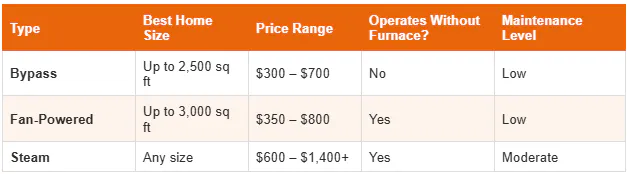
Bypass humidifiers are the most widely installed whole-home option across Ontario and across Canada. They operate by routing a portion of the warm air from your furnace through a water-soaked evaporator pad. As the warm air passes through the pad, it picks up moisture and carries it into your duct system, which distributes the humidified air throughout your home.
The key characteristic of a bypass humidifier is that it depends entirely on your furnace fan to move air through the unit. This means it only operates when the furnace is actively running. For most Ontario homeowners, this is not a problem, since the furnace runs frequently throughout the heating season. However, in milder shoulder-season months, performance can be limited.
Bypass humidifiers are the most affordable option, both in terms of purchase price and installation cost, and they are well-suited to homes up to approximately 2,500 square feet. They require annual water panel replacement and occasional cleaning, but day-to-day operation is completely hands-off.
Fan-Powered Humidifiers
Fan-powered humidifiers work on the same evaporation principle as bypass models, but they include their own dedicated fan. This allows the unit to push air across the water panel independently — even when the furnace is not running. The result is more consistent humidity control across the full heating season, including the shoulder periods in fall and spring.
Because they operate independently of the furnace fan, fan-powered humidifiers also produce greater moisture output than bypass models of comparable size. This makes them a better fit for homes between 2,000 and 3,000 square feet, or for homes with open floor plans where more humidity output is needed to keep the whole space comfortable.
The price premium over a bypass unit is modest — typically $50 to $150 more for the unit itself — and most homeowners who need better shoulder-season performance find the upgrade well worth it.
Steam Humidifiers
Steam humidifiers are the most powerful, most precise, and most versatile whole-home humidification option available. Rather than evaporating water through a pad, a steam humidifier uses an electric heating element to boil water and produce pure steam, which is then injected directly into the airstream. Because steam is generated electrically, the unit operates completely independently of your furnace — it can add moisture to your home's air at any time, regardless of whether the heating system is running.
Steam humidifiers deliver the highest moisture output of any residential system, making them ideal for large homes over 3,000 square feet, homes with very high ceilings, open-concept layouts, or older construction with higher air leakage rates. They are also the best choice for homes with hydronic (hot water or radiator) heating systems that do not use forced-air ductwork, where a separate blower cabinet can distribute the steam.
The trade-off is cost. Steam humidifiers carry a higher upfront price and slightly higher operating costs due to their electricity consumption. They also require more regular maintenance, specifically the replacement of the steam canister or cylinder, typically once per season. For homeowners who want the absolute best in indoor air quality and precision control, the investment is justified.
Choosing the right size humidifier is just as important as choosing the right type. An undersized unit will struggle to maintain adequate humidity levels, running constantly without achieving its target. An oversized unit can over-humidify, leading to condensation on windows, dampness in walls, and potential mould growth.
Humidifier capacity is measured in gallons per day (GPD) — the maximum amount of moisture the unit can add to your home's air over a 24-hour period. Here are general sizing guidelines for Ontario homes with average insulation and a standard eight-foot ceiling height:
- Up to 1,500 sq ft: Look for a unit rated at 6 to 9 GPD
- 1,500 to 2,500 sq ft: Look for a unit rated at 9 to 12 GPD
- 2,500 to 3,500 sq ft: Look for a unit rated at 12 to 18 GPD
- Over 3,500 sq ft: Look for a steam unit rated at 18 GPD or higher
These are starting-point guidelines. Your actual needs may differ depending on several factors. Older homes with less insulation and higher air leakage rates lose humidity faster and may need a higher-capacity unit than the square footage alone would suggest. Homes with many large windows experience greater heat loss and humidity loss at the glass. Homes with hardwood floors or valuable wood furniture may benefit from a more powerful system to maintain tighter humidity control. A professional assessment by a trained HVAC technician is always the most reliable way to size a humidifier correctly.
Once you have identified the right type and approximate size, here are the specific features worth evaluating as you compare models:
Humidistat Quality and Accuracy
The humidistat is the brain of your whole-home humidifier system. A basic humidistat simply turns the unit on and off based on a fixed setting. A better quality digital humidistat measures both indoor temperature and indoor humidity and adjusts the humidifier's output accordingly. The best models also factor in outdoor temperature — automatically reducing the humidity setpoint on very cold days to prevent window condensation. If your HVAC system has a smart thermostat, look for humidifier models that integrate directly with it for seamless, unified control from a single device.
Moisture Output Capacity
Always verify the unit's stated moisture output (in GPD) matches your home's calculated needs. Be aware that manufacturers sometimes list maximum theoretical output under ideal conditions. Ask your HVAC contractor for real-world performance expectations based on your specific home and climate.
Water Efficiency
Traditional bypass humidifiers use a drain to flush excess water and mineral buildup out of the unit, which means some water is wasted during operation. Drainless or flow-through models recirculate water more efficiently, reducing waste. If water conservation or water costs are a concern, ask specifically about drainless models.
Ease of Maintenance
Look for a humidifier with easy access to the water panel or steam canister for seasonal servicing. Some models feature a tool-free panel that clips in and out in seconds. Others require more disassembly. This matters more than it might seem — easier maintenance means you or your technician are more likely to actually perform it on schedule, which directly affects performance and longevity.
Compatibility with Your HVAC System
Not every humidifier is compatible with every furnace or air handler. Factors like duct size, available mounting location (supply or return side), and the furnace's airflow capacity all affect compatibility. Some premium humidifiers also require a dedicated electrical circuit. Always confirm compatibility before purchasing, and rely on a certified HVAC technician to make the final call.
Warranty Coverage
Whole-home humidifiers should come with a manufacturer's warranty of at least one to two years on parts. Some premium brands offer five-year or longer warranties on specific components. Ask about warranty terms before you buy, and confirm whether the warranty requires professional installation to remain valid — most do.
Even well-intentioned buyers sometimes make choices they later regret. Here are the most common pitfalls to steer clear of:
Choosing the Cheapest Unit Without Considering Long-Term Costs
A very inexpensive humidifier may seem like a bargain upfront but could cost more over time through higher maintenance costs, shorter service life, or poor performance that leads you to replace it sooner than expected. Evaluate the total cost of ownership — purchase price, installation, annual maintenance, and expected lifespan — not just the sticker price.
Skipping Professional Sizing and Installation
A humidifier that is the wrong size for your home will either fail to make a meaningful difference or will over-humidify, causing condensation and potential mould problems. Professional sizing, based on a proper assessment of your home's square footage, construction, and insulation, is essential. Similarly, improper installation can result in water leaks, HVAC compatibility issues, and voided warranties.
Neglecting the Water Supply and Drain Requirements
Whole-home humidifiers require a connection to your home's water supply line and, in most cases, a floor drain or condensate drain for excess water. If your furnace location does not have easy access to both, installation costs will be higher. Factor this into your budget planning before committing to a purchase.
Ignoring Your Water Quality
Ontario's tap water varies significantly in hardness from one municipality to another. Hard water — water with a high mineral content — accelerates the buildup of scale on humidifier components, requiring more frequent maintenance and potentially shortening the unit's lifespan. If your home has hard water, ask your contractor about models designed to handle it, or consider whether a water softener installation makes sense alongside your humidifier.
Buying a Whole-Home Unit Without an Existing Forced-Air System
Standard bypass and fan-powered humidifiers require a forced-air furnace and ductwork to function. If your home uses a different heating system — such as a boiler, electric baseboard heaters, or a mini-split system — you will need either a steam humidifier with a standalone blower cabinet or a different solution entirely. Always confirm compatibility with your existing heating system before purchasing.
Many Ontario homeowners start with a portable room humidifier and later upgrade to a whole-home system. Here is why the upgrade almost always makes sense:
Portable humidifiers treat a single room at a time, leaving the rest of the house dry. They require daily or near-daily refilling with water, regular cleaning to prevent mould and bacteria growth inside the tank, and they produce noise during operation. Over the course of a heating season, the time and effort involved in maintaining one or more portable units adds up significantly.
A whole-home humidifier, by contrast, connects directly to your water supply, so it never needs to be refilled. It treats every room in the house simultaneously through your existing ductwork. It runs automatically based on your humidistat settings. The only maintenance required is an annual water panel or canister replacement and a once-a-season cleaning — tasks that take less than an hour per year.
When you factor in the ongoing inconvenience of portable units, the cost of replacement filters, the risk of mould in poorly maintained portable tanks, and the fact that portable units simply cannot match the whole-home coverage of a central system, the case for a whole-home humidifier becomes very clear.
A whole-home humidifier is a low-maintenance system, but understanding what maintenance is required before you purchase will help you plan accordingly and avoid any surprises.
For bypass and fan-powered humidifiers, the primary maintenance task is replacing the evaporator water panel once per heating season — or twice if your home has very hard water. This is a simple task that most homeowners can do themselves in about 15 minutes, or it can be included in your annual HVAC tune-up. The humidifier housing and water distribution tray should also be cleaned at this time to remove mineral deposits and prevent any biological growth.
For steam humidifiers, the steam canister or cylinder needs to be replaced on a schedule determined by your water hardness and the volume of steam produced — typically once per season. Some premium steam models include self-cleaning functions that extend canister life and reduce the frequency of replacement.
All whole-home humidifiers benefit from annual professional maintenance, ideally at the start of the heating season. A certified technician will inspect the water supply connection, check the humidistat calibration, clean all accessible components, and confirm the unit is operating within its rated parameters. This annual service is the single most effective thing you can do to maximize the lifespan and performance of your investment.
Choosing the right whole-home humidifier is easier when you have an experienced HVAC partner on your side. Constant Home Comfort has been helping Ontario homeowners improve their indoor air quality for years, providing expert guidance, transparent pricing, and professional installation across Toronto, the GTA, Hamilton, Ottawa, Barrie, London, Waterloo, and communities throughout the province.
When you book a free in-home consultation with our team, a certified HVAC technician will assess your home's size, construction, existing heating system, and local water conditions to recommend the right type, brand, and model of humidifier for your needs and budget. We carry and install leading brands known for performance and reliability, and we back every installation with our service guarantee.
We also offer flexible financing options and will advise you on any Ontario government rebates or incentive programs that may apply to your indoor air quality upgrade. There is no pressure and no upselling — just honest, expert advice and a commitment to getting it right.
Contact Constant Home Comfort today to book your free consultation and take the first step toward a healthier, more comfortable home this winter.
Call us at 1 (888) 675-5907 or book your appointment online at constanthomecomfort.com