 Work Time
Before comparing models, it's worth confirming that a ventilator is the right solution for your situation. You likely need one if your home shows any of the following signs:
- Condensation or frost regularly forming on windows in winter
- Persistent stale, musty, or "closed-in" odours indoors
- Elevated CO2 levels causing fatigue or difficulty concentrating (especially with work-from-home households)
- Visible mould or mildew in bathrooms, closets, or the basement
- Family members with recurring allergy, asthma, or respiratory symptoms that worsen at home
- A recently air-sealed, insulated, or newly built home with no mechanical ventilation
- A home renovation that added insulation, new windows, or weatherstripping
Ontario's building code now requires mechanical ventilation in all new construction — a clear acknowledgement that today's energy-efficient homes need active ventilation to stay healthy. If your home was built or significantly renovated after 2012, there's a very good chance a ventilator was already installed. If it's older or has had recent upgrades, adding one is highly recommended.
This is the most common question homeowners ask, and the answer comes down to two factors: your home's typical humidity level and your climate zone within Ontario.
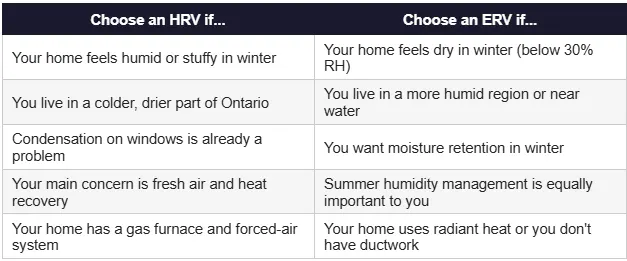
For most homeowners across the GTA, Hamilton, and the rest of southern Ontario, an HRV is the most practical choice. Ontario winters are cold and dry enough that allowing indoor moisture to exhaust with the stale air — while recovering the heat — produces the ideal balance. An ERV makes more sense in situations where the home runs very dry or where summer humidity must be actively managed.
Still unsure? Our technicians will perform a humidity assessment during your free in-home visit and give you a clear recommendation before you decide anything.
Ventilator sizing is measured in cubic feet per minute (CFM) — the volume of air the unit can move per minute. An undersized unit won't adequately refresh your indoor air, while an oversized unit can create pressure imbalances and waste energy. Proper sizing depends on several factors:
Home Square Footage
As a general guideline, ventilators are rated for homes up to a certain square footage. The Lennox Healthy Climate HRV, for example, is rated for homes up to 4,200 square feet. For most Ontario detached homes, a unit in the 100–200 CFM range is appropriate, while condos and smaller homes may only require 60–100 CFM.
Number of Occupants
Canada's ventilation standard (ASHRAE 62.2) recommends a specific amount of fresh air per occupant. A household of five people requires meaningfully more ventilation than a couple living in the same-sized house. More occupants mean more CO2, moisture, and pollutants generated daily.
Airtightness of the Home
A newly built, well-sealed home needs a higher-capacity ventilator than an older, naturally drafty home — because there's less accidental fresh air exchange happening through gaps in the building envelope. A blower door test (which measures how airtight your home is) gives the most accurate sizing data.
Number of Bedrooms and Bathrooms
Bedrooms and bathrooms are the primary sources of moisture and CO2 at night. Ontario building code uses number of bedrooms as one of the key inputs in calculating required ventilation rates, so a 5-bedroom home requires more airflow than a 2-bedroom condo regardless of square footage.
Use the general sizing guide below as a starting point. Your installer will refine this based on your specific home during the assessment:
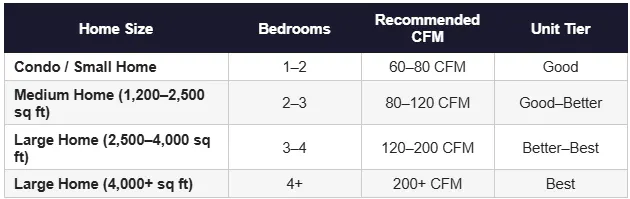
* CFM figures are approximate. Your installer will calculate the precise requirement based on your home's airtightness and layout.
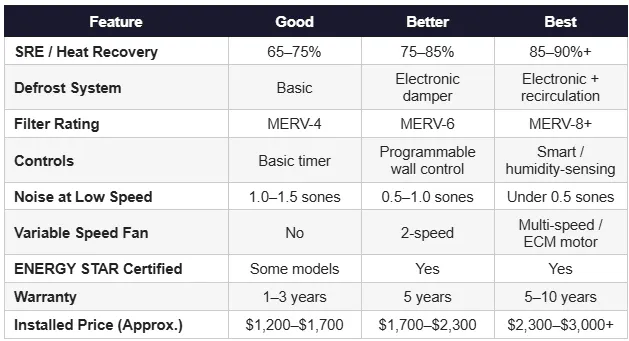
Not all ventilators are built the same. Here are the features that genuinely make a difference in day-to-day performance — and the ones you can safely skip.
Heat Recovery Efficiency (SRE)
The Sensible Recovery Efficiency (SRE) rating tells you how much of the outgoing heat is captured and transferred to the incoming air. A higher SRE means lower operating costs. Look for an SRE of 70% or higher — premium units like the Lennox Healthy Climate HRV achieve up to 90%.
Defrost Mechanism
In Ontario winters, the cold incoming air can cause frost to build up inside the heat-exchange core, reducing airflow and efficiency. A good defrost mechanism — either an electronically controlled damper or a recirculation mode — prevents this automatically. This is not optional in our climate; make sure your unit has it.
Filtration
All ventilators include basic filters, but quality varies. A MERV-4 washable filter handles larger particles like dust and pet dander. If anyone in your household has allergies or asthma, consider a unit with MERV-6 or higher filtration, or one that can integrate with your existing whole-home air cleaner.
Controls and Programmability
Basic ventilators include a simple on/off timer. Better units offer programmable wall controls that let you set ventilation schedules — running at higher speed during peak hours (mornings, evenings, and cooking times) and lower speed overnight. Some premium models integrate with smart home systems or adjust ventilation rates automatically based on indoor humidity sensors.
Sound Levels
If your ventilator is near bedrooms or living areas, noise matters. Look for units rated under 1.0 sone at low speed, which is near-silent in normal conditions. Most premium units include a quiet or "sleep" mode for nighttime operation. Ask your installer where the unit will be mounted and whether sound attenuation is needed.
Warranty
A 5-year limited warranty is the baseline for a quality unit — the Lennox Healthy Climate HRV includes exactly this. Longer warranties (up to 10 years on some models) are available at the premium tier. Note that warranties are typically voided by improper installation, which is another reason professional installation matters.
ENERGY STAR Certification
ENERGY STAR certified ventilators meet strict efficiency requirements set by Natural Resources Canada. Choosing a certified unit ensures your equipment will deliver on its efficiency claims — and may also make you eligible for additional rebates.
One of the most important practical questions is how a new ventilator will integrate with your current heating and cooling setup. Here's what to know for the most common home types in Ontario:
Forced-Air Furnace (Most Common)
This is the easiest and most cost-effective integration. The ventilator connects to your existing supply and return ductwork, and the furnace fan distributes the fresh pre-conditioned air throughout your home. This setup works for the vast majority of Ontario homes and requires no additional ductwork beyond the intake and exhaust connections.
Ductless or Mini-Split Systems
Homes heated by ductless mini-splits, heat pumps, or radiant floor systems have no existing ductwork to leverage. A ventilator can still be installed using dedicated supply and exhaust ducts — typically smaller ducts routed to key rooms like bedrooms and the living area. The installation is more involved but very achievable.
Boiler / Radiator Systems
Similar to ductless systems, boiler-heated homes require dedicated ventilation ductwork. Our installers design a distribution layout appropriate for your home's floor plan so that every occupied room receives adequate fresh air.
Existing HRV Replacement
If you're replacing an older ventilator, the new unit often connects to the existing ductwork with minimal modifications. This is typically the most affordable installation scenario, since the infrastructure is already in place.
Your ventilator is only as good as its installation. Even a premium unit will underperform — or create safety hazards — if it's improperly installed. Here are the key things to look for and ask before hiring anyone:
- Are they licensed and insured? Always verify that the company holds a valid TSSA registration and carries full liability insurance.
- Do they perform a home assessment before quoting? A reliable installer will visit your home, measure airflow requirements, assess your ductwork, and provide a fixed quote — not a rough estimate over the phone.
- Is airflow balancing included? A properly installed HRV or ERV must have equal intake and exhaust airflow. Without balancing, you'll have pressure imbalances that can affect your furnace, dryer, and other appliances.
- Do they handle rebate paperwork? A good installer will identify applicable government and utility rebates and process the applications for you.
- What does the warranty cover? Ask specifically whether the labour warranty is separate from the equipment warranty, and how long each lasts.
- Are they available after installation? Post-installation support matters. You want a company with 24/7 availability in case questions or issues arise after the job is done.
Bring this list to your installer consultation. Any reputable provider should be able to answer every question clearly and confidently.
- What type of ventilator — HRV or ERV — do you recommend for my home, and why?
- What CFM capacity do I need based on my home's size, layout, and number of occupants?
- What SRE rating does the unit you're recommending have?
- How will the ventilator connect to my existing HVAC system, and will any new ductwork be needed?
- Is airflow balancing included in the installation price?
- What defrost mechanism does the unit use, and how does it perform in our climate?
- What's included in the total installed price — are controls, exterior hoods, and wiring all covered?
- What rebates or incentives am I eligible for, and will you process the paperwork?
- What does the warranty cover, and for how long — both parts and labour?
- What maintenance will I need to do, and how often?
A ventilator is a low-maintenance piece of equipment, but it does need regular attention to perform at its best. Here's a simple maintenance schedule to keep in mind:
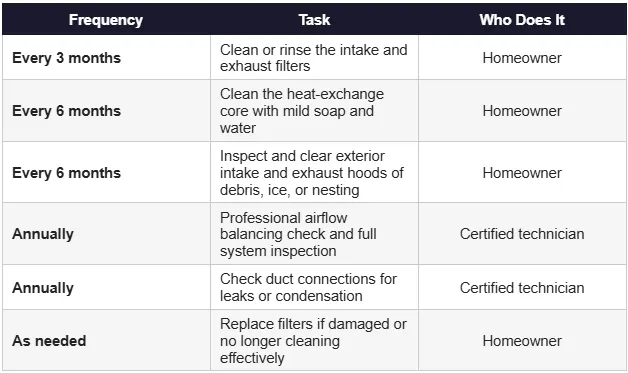
Constant Home Comfort offers annual maintenance plans that cover your ventilator along with your other HVAC equipment — one plan, one call, complete peace of mind.
Sticker shock is common when homeowners first see ventilator installation quotes — but the actual out-of-pocket cost is almost always lower, and the long-term return is significant.
Available Rebates for Ontario Homeowners
- Home Renovation Savings Program (HRSP): Qualifying ventilation upgrades may be eligible for rebates when combined with other home efficiency improvements.
- Enbridge Home Efficiency Rebates: Enbridge Gas customers may be eligible for rebates on qualifying HRV and ERV installations.
- Canada Greener Homes Loan: Interest-free financing of up to $40,000 for eligible energy efficiency retrofits, which can include ventilation when bundled with other qualifying upgrades.
- Lennox Manufacturer Rebates: Periodic seasonal promotions from Lennox provide additional savings on the unit itself.
Financing Options Through Constant Home Comfort
- $0 down, 0% interest for 12 months (O.A.C.) — install today, spread payments interest-free
- Longer-term monthly payment plans available for homeowners who prefer smaller monthly amounts
- Same-day approval — quick and simple process with no need to visit a bank
- Choosing based on price alone. The cheapest unit rarely delivers the lowest total cost of ownership. Energy savings, longevity, and maintenance costs all factor into the real value of your purchase.
- Skipping the home assessment. Buying a unit online and hiring someone to install it without a proper assessment often results in incorrect sizing, poor integration, and missed rebate opportunities.
- Neglecting airflow balancing. An unbalanced ventilator creates negative or positive pressure inside your home, which can cause backdrafting of combustion gases from your furnace or water heater — a serious safety issue.
- Ignoring the defrost mechanism. In Ontario winters, a ventilator without an effective defrost system will ice up, reduce airflow, and potentially shut down entirely during the coldest periods when you need it most.
- Forgetting about maintenance. A ventilator with clogged filters or a dirty heat-exchange core can lose 30% or more of its efficiency. Budget for regular maintenance when you're calculating the full cost of ownership.
- Choosing ERV when HRV is more appropriate. In most of Ontario's climate, an HRV is the right choice. Installing an ERV in an already-humid home can worsen condensation problems in winter.
We've helped thousands of Ontario homeowners breathe easier — and we've earned that trust by doing things the right way every time.
- Free in-home assessment with no obligation — we visit your home, measure what you need, and give you a firm quote on the spot
- Certified, licensed technicians for every installation — no subcontracting, no surprises
- Top-brand ventilators including the Lennox Healthy Climate HRV and ERV, purpose-built for Canadian climates
- Full rebate assistance — we find the programs you qualify for and handle all the paperwork
- Flexible financing from $0 down, 0% interest (O.A.C.), with same-day approval
- 24/7 support — we're always available if you have a question or need service after installation
- Serving all of Ontario — GTA, Hamilton, Ottawa, London, Waterloo, Windsor, and surrounding areas
Can a ventilator be installed in a condo?
Yes, though condos have specific requirements around venting to the exterior. Many condos already have dedicated ventilation systems, and if yours is aging or underperforming, it can often be replaced with a more efficient unit. Always check with your building management regarding exterior modifications before proceeding.
Will a ventilator help with cooking odours and VOCs?
Yes. A properly sized and balanced ventilator continuously flushes indoor air, which reduces the concentration of cooking odours, VOCs from furniture and cleaning products, and other airborne pollutants. Running the ventilator on high during and after cooking speeds up the process.
Does a ventilator help with radon?
A ventilator helps dilute radon by continuously introducing fresh outdoor air, which reduces the concentration of radon indoors. However, if radon levels are significantly elevated, a dedicated radon mitigation system (sub-slab depressurization) is the recommended primary solution, with a ventilator as a complementary measure.
How long does installation take?
Most standard installations are completed in a single day — typically 4 to 8 hours. Installations requiring new dedicated ductwork in a ductless home may take longer or require a follow-up visit. We provide a clear timeline estimate during your in-home assessment.
What if my existing HRV is only a few years old — should I still replace it?
Not necessarily. If your existing ventilator is working correctly, properly balanced, and maintained, it may have many years of useful life remaining. Our technicians can assess your current unit during a service visit and advise whether repair, maintenance, or replacement makes the most financial sense for your situation.
You now have everything you need to make a confident ventilator decision. When you're ready to move forward, the Constant Home Comfort team is here to make the process seamless — from your free in-home assessment through to installation, rebate claims, and beyond.
Call us 24/7 at 1 (888) 675-5907, or submit a request online. We serve homeowners across the GTA, Hamilton, Ottawa, London, Waterloo, Windsor, and all of Ontario — and we'll typically have a technician at your door within 1–2 business days.
Call 1 (888) 675-5907 | Free In-Home Assessment | No Obligation