 Work Time
Before diving into specs and models, it is worth confirming that a conventional tank is the best type of system for your household. Here is a quick overview of who benefits most from a conventional tank water heater:
- You want a straightforward, lower-cost solution that works reliably without a steep learning curve or complicated installation.
- Your home already has a tank water heater and you want a like-for-like replacement with minimal disruption.
- Your household has predictable, moderate hot water demand — not extreme back-to-back usage across multiple bathrooms simultaneously.
- You prefer a lower upfront cost and are comfortable with slightly higher monthly energy use compared to a tankless system.
- Your home's infrastructure (gas lines, venting, electrical) may not easily support a tankless upgrade without significant additional cost.
If any of these describe your situation, a conventional tank water heater is an excellent choice. If you are still unsure, our advisors are happy to walk you through all your options at no cost.
Tank size is the single most important factor in your buying decision. A tank that is too small means you will regularly run out of hot water. A tank that is too large wastes energy heating and maintaining more water than you actually use.
The two measurements that matter most are storage capacity (how many gallons or litres the tank holds) and First Hour Rating (FHR) — the amount of hot water the unit can deliver in the first hour of use starting from a full tank. For most households, matching your FHR to your peak hour demand is more accurate than sizing by gallons alone.
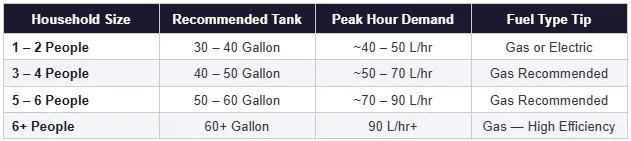
Note: These are general guidelines. Factors such as high-efficiency fixtures, laundry habits, and bathtub vs. shower use can shift your ideal tank size. Our team will conduct a proper hot water needs assessment during your consultation.
For most Ontario homeowners, the choice between gas and electric will come down to what fuel source is already available in your home and your long-term energy cost priorities.
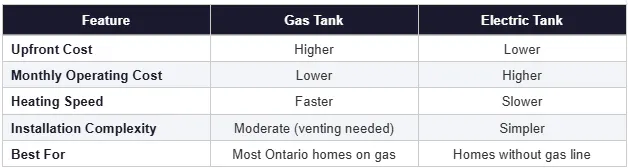
In most Ontario markets, natural gas costs less per unit of energy than electricity, which is why gas tank water heaters tend to have lower monthly operating costs despite a higher purchase price. Over a 10 to 12 year lifespan, the operating savings of a gas unit often exceed the upfront price difference.
If your home does not currently have a gas connection, the cost of running a new gas line needs to be factored in. In that case, electric may remain the more practical option depending on your budget. Our technicians will assess your home's current setup and give you an honest recommendation.
All water heaters sold in Canada are required to display a Uniform Energy Factor (UEF) rating — a standardized measure of how efficiently the unit converts energy into hot water. The higher the UEF, the more efficient the unit and the lower your monthly energy bill.
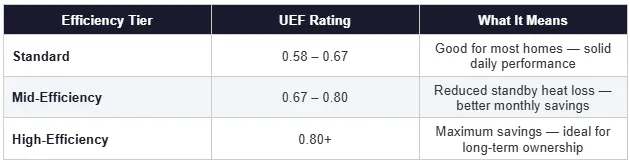
One important efficiency consideration specific to conventional tanks is standby heat loss — the energy consumed to keep water hot even when you are not using it. This is an unavoidable characteristic of storage tank systems. High-efficiency models minimize standby loss through better tank insulation and more responsive heating elements or burners.
For most Ontario homeowners planning to stay in their home for 5 or more years, investing in a mid- to high-efficiency model delivers meaningful savings over the life of the unit. Our team can help you calculate the payback period for any model you are considering.
Not all conventional tank water heaters are built the same. The brand you choose affects build quality, long-term reliability, and the protection you have if something goes wrong. Constant Home Comfort carries two of the most trusted brands in the Canadian market:
Bradford White
Bradford White is widely recognized as one of North America's most reliable water heater manufacturers. Their conventional tank models are built with durable materials, feature excellent corrosion protection, and come backed by strong warranty coverage — typically 6 to 10 years on the tank itself. Bradford White units are a top choice for homeowners who want long-term peace of mind and are willing to invest slightly more upfront for a premium product.
- Best for: Homeowners prioritizing longevity, corrosion resistance, and comprehensive warranty coverage
- Available in: Gas (atmospheric and power vent) models
Giant
Giant is a well-established Canadian brand with a strong track record in Ontario homes. Their conventional tank models offer a practical balance of performance and affordability, making them a popular choice for budget-conscious homeowners who still want a reliable, Canadian-made product.
- Best for: Homeowners looking for solid performance at a more accessible price point
- Available in: Electric tank models including point-of-use options
What to Look for in a Warranty
When comparing warranties, pay close attention to these three things:
- Tank warranty: How many years the inner tank itself is covered against leaks or failure (typically 6–10 years on premium models)
- Parts warranty: Coverage for components like the burner, heating elements, and thermostat
- Labour warranty: Whether the manufacturer or installer covers labour costs if a warranty repair is needed
If you are purchasing a gas conventional tank water heater, your home will need appropriate venting to safely exhaust combustion gases. There are two main venting configurations:
Atmospheric Vent (Natural Draft)
The most common type found in older Ontario homes. Combustion gases rise naturally through a vertical flue pipe and exit through the roof or chimney. Atmospheric vent models are simple, widely available, and the most affordable to install when existing venting infrastructure is already in place.
Power Vent
Power vent models use an electric fan to push exhaust gases through a horizontal PVC pipe, allowing much more flexibility in where the unit is installed — particularly in homes without a traditional chimney or vertical vent. Power vent units are slightly more expensive but open up installation options that atmospheric venting does not allow.
Our licensed technicians will assess your home's venting setup during a free pre-installation inspection and recommend the most suitable and cost-effective configuration for your specific situation.
The sticker price of a water heater is only one part of what you will actually spend over the life of the unit. Smart buyers consider the full cost of ownership, which includes:
- Purchase price of the unit: $500 – $1,400 depending on size, type, and brand
- Installation cost: $200 – $550 (higher if venting upgrades or gas line work is required)
- Monthly energy cost: Gas tanks average $25 – $45/month in Ontario; electric tanks average $40 – $65/month depending on usage
- Maintenance: Annual anode rod checks, periodic flushing, and T&P valve testing — typically $100 – $200/year if done professionally
- Lifespan: 10 – 15 years with proper maintenance
When you add these numbers up over 12 years, the difference between a standard-efficiency and high-efficiency model — or between gas and electric — becomes much more significant than the upfront price tag alone suggests. Our advisors are happy to walk you through a full cost-of-ownership comparison for any models you are considering.
A conventional tank water heater is a relatively low-maintenance appliance, but a few routine tasks will protect your investment, extend the unit's lifespan, and keep your warranty valid:
- Flush the tank annually — Sediment from Ontario's hard water accumulates at the bottom of the tank over time, reducing efficiency and causing the characteristic rumbling noise. An annual flush removes this buildup.
- Inspect and replace the anode rod every 3–5 years — The anode rod is your tank's primary defence against internal corrosion. Once it is depleted, the tank itself begins to corrode from the inside out. Replacing it on schedule is the single best thing you can do to extend your tank's life.
- Test the T&P (temperature and pressure relief) valve annually — This critical safety valve prevents dangerous pressure buildup inside the tank. A quick annual test confirms it is operating correctly.
- Check the burner and venting (gas models) — An annual inspection by a licensed technician ensures the burner is operating cleanly and the venting is free of obstructions.
- Enroll in a Water Heater Maintenance Plan — Constant Home Comfort's maintenance plan covers annual servicing so you never have to remember to schedule it yourself, and keeps your unit running at peak efficiency year after year.
Whether you are buying new or having a unit installed, here are the warning signs that should give you pause:
- No licensed installation — In Ontario, water heater installation must be performed by a licensed technician. Unlicensed installation voids your warranty and may violate local building codes.
- No permit when required — If your installation involves changes to gas lines, venting, or electrical connections, a permit is required. A contractor who skips this step is cutting corners.
- Unusually low quotes — A dramatically low installation price often means something is being skipped, such as permits, quality parts, or proper venting.
- Pressure to buy the wrong size — A reputable installer will always assess your actual hot water needs before recommending a size, not just quote the cheapest available unit.
- No written warranty documentation — Always ask for the warranty terms in writing before committing to a purchase.
If you are still weighing a conventional tank against a tankless water heater, here is the clearest way to think about it:
- Choose a conventional tank if your priority is lower upfront cost, straightforward installation, and reliable everyday performance for a household with moderate hot water demand.
- Choose a tankless system if your priority is maximum long-term energy savings, unlimited hot water on demand, and you are comfortable with a higher initial investment.
There is no universally right answer — it depends on your home, your budget, and how long you plan to stay. Our team will give you a straight, pressure-free recommendation based on your specific situation.
Constant Home Comfort makes buying and installing a conventional tank water heater as simple as possible for Ontario homeowners. When you call us, you get:
- A free, no-obligation quote with honest recommendations based on your home's needs
- Installation by licensed, experienced technicians who handle all permits
- Access to 0% interest financing with $0 down, available O.A.C.
- Rebate application support — we handle all the paperwork on your behalf
- 24/7 availability for service, sales, and emergency repairs
- Service across the GTA, Hamilton, Ottawa, London, Waterloo, Barrie, Burlington, and all of Ontario
Call us anytime at 1-888-675-5907 for a free quote on the spot. We will help you find the right unit, at the right price, with a seamless installation you can count on.
How do I know when it is time to replace my conventional tank water heater?
If your unit is over 10 years old, running out of hot water faster than it used to, making unusual noises, showing rust in the water, or leaking — it is time to replace it. An older unit operating inefficiently also costs more to run every month, meaning the longer you wait, the more you spend.
What tank size do I need for a family of 4?
A 50-gallon gas tank is the most common recommendation for a family of 4 in Ontario. If your household includes teenagers or back-to-back showers are a regular occurrence, sizing up to a 60-gallon unit may be worth the modest price difference.
How long does installation take?
A standard conventional tank swap typically takes 2 to 4 hours. More complex installations involving venting upgrades, gas line work, or permit inspections may take longer. Our team will give you a realistic timeline before the work begins.
Can I get a rebate on a conventional tank water heater in Ontario?
Rebate availability for conventional tanks varies by program and model. High-efficiency units that meet Energy Star criteria may qualify for utility or government rebates. Constant Home Comfort will check your eligibility at the time of your quote and handle all rebate applications on your behalf.
What is the difference between atmospheric vent and power vent gas water heaters?
An atmospheric vent model relies on natural draft to vent exhaust gases up through a vertical flue — ideal for homes with a chimney or existing vertical vent. A power vent model uses an electric fan to push exhaust out horizontally through PVC pipe, offering more installation flexibility for homes without traditional venting. Our technicians will determine which type is appropriate for your home during the pre-installation inspection.
Does Constant Home Comfort offer a rental program for water heaters?
Yes. If you prefer not to purchase outright, our Water Heater Rental Program provides a professionally installed unit for a low monthly fee that includes maintenance coverage. Ask your advisor for current rental rates and program details.